Guides
Knowledge Hub
VELTAA’s Knowledge Hub offers practical, engineering-based insights on aluminum joinery, facade systems, material performance, durability, insulation, installation techniques, and global standards. A curated resource for homeowners, architects, and contractors seeking reliable, long-lasting solutions in aluminum architecture.
U.S. Standards for Aluminum Doors, Windows & Sliding Systems
Understanding the Right Standards for Aluminum Doors, Windows, and Sliding Systems in the U.S. Market.
In the United States, aluminum doors, windows, and sliding systems are evaluated not only based on aesthetics or basic technical capability, but primarily on compliance with the correct performance standards.
A system may appear architecturally flawless; however, if it has not passed the required tests, it may be rejected during permitting, excluded from insurance coverage, or pose serious risks under extreme weather conditions.
Especially in the U.S. market, European standards are often not considered sufficient. For this reason, understanding which standards are required before starting a project is critical to long-term success.
Why Are Standards So Important for Aluminum Windows and Door Systems in the U.S.?
In the U.S., building inspections focus less on visual appearance and more on testing methodologies, performance durability, and certification processes issued by authorized institutions.
The most commonly encountered standards include:
- AAMA – performance and quality standards
- NAFS – unified performance evaluation for doors and windows
- ASTM – material-based durability testing
- Miami-Dade (NOA) – highest-level safety approval for hurricane-prone regions
Each standard addresses a different risk and performance requirement.
AAMA — The Core Reference for Performance and Quality
The American Architectural Manufacturers Association (AAMA) is one of the most influential organizations defining performance and quality criteria for architectural products in the U.S.
AAMA standards cover:
- Air infiltration resistance
- Water penetration resistance
- Wind load performance
- Long-term durability and safety requirements
These standards ensure that door, window, and façade systems can be used safely in both residential and commercial projects.
Compliance with AAMA is a key indicator that a system is technically ready for the U.S. market.
NAFS — Unified Performance Standard for Doors and Windows
The North American Fenestration Standard (NAFS) provides a comprehensive framework for evaluating aluminum doors and windows under a single performance system.
NAFS testing includes:
- Air leakage
- Water resistance
- Structural performance
- Adaptation to regional climate conditions
NAFS is particularly important for:
- Residential developments
- Multi-story buildings
- Projects across diverse climate zones
It clearly classifies system performance levels based on real-world conditions.

ASTM — Proof of Material-Level Durability
The American Society for Testing and Materials (ASTM) focuses on testing the materials used within a system, rather than the assembled product alone.
Through ASTM standards, the following are verified internationally:
- Mechanical strength of aluminum profiles
- Impact and pressure resistance of glass
- Aging and environmental performance of EPDM gaskets
- Reliability of fasteners and connection elements
ASTM compliance plays a critical role in enabling products to be accepted across global markets.

Miami-Dade (NOA) — The Highest Level of Safety for Hurricane Zones
The Miami-Dade County Notice of Acceptance (NOA) is one of the strictest approval systems developed for areas exposed to extreme weather—especially coastal and hurricane-prone regions.
Miami-Dade certification tests products against:
- Extreme wind speeds
- High pressure differentials
- Impact from flying debris
This approval documents that a system can be used safely even under the most severe environmental conditions.

Which Standards Should Be Prioritized for Each Project?
Not every project requires the same standards at the same level.
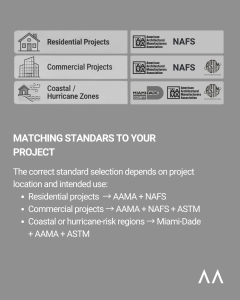
The correct standard selection depends on project location and intended use:
Residential projects → AAMA + NAFS
Commercial projects → AAMA + NAFS + ASTM
Coastal or hurricane-risk regions → Miami-Dade + AAMA + ASTM
Compliance with standards is therefore not just a technical requirement, but a long-term safety and investment decision.
Why Standards Compliance Is an Investment — Not a Cost
Systems that comply with the correct standards:
- Pass inspection processes smoothly
- Provide advantages during permitting and insurance approvals
- Reduce long-term maintenance and replacement costs
- Increase user safety
- Enhance overall project value
In short, standards reduce risk and build trust.
Conclusion: Safety Starts with the Right Standards
In the U.S. market, strong design alone is not enough.
Systems must be tested and certified according to the correct standards.
Aluminum systems developed in compliance with international standards deliver reliable performance, safety, and long-term value—today and for years to come.
Frequently Asked Questions
Why are U.S. standards mandatory for aluminum door and window systems?
In the U.S., building approvals are based on tested performance rather than visual design. Systems that do not comply with standards such as AAMA, NAFS, ASTM, or Miami-Dade may be rejected during permitting, excluded from insurance coverage, or fail under extreme weather conditions.
Are European standards sufficient for projects in the U.S.?
In most cases, no. While European standards may indicate product quality, they are often not accepted as a substitute for U.S. performance standards. U.S. authorities require compliance with region-specific testing and certification systems.
What is the difference between AAMA and NAFS standards?
AAMA defines performance and quality requirements for architectural products, while NAFS provides a unified performance classification system specifically for doors and windows. In practice, both standards are often required together for full compliance.
When is Miami-Dade certification required?
Miami-Dade certification is essential for projects located in hurricane-prone and coastal regions, particularly in Florida. It verifies resistance to extreme wind loads, pressure differences, and impact from flying debris.
Does ASTM testing apply to the entire system or individual materials?
ASTM focuses on material-level testing, including aluminum profiles, glass, EPDM gaskets, and fasteners. These tests validate durability, mechanical strength, and environmental resistance of individual components.
Do all projects need to comply with every standard?
No. The required standards depend on the project type and location. Residential projects may require fewer certifications than commercial or coastal developments. Selecting the correct standards is a strategic decision tied to safety, approval, and long-term performance.
Is standards compliance a cost or an investment?
Standards compliance is a long-term investment. Certified systems reduce approval risks, lower maintenance costs, improve safety, and increase the overall value and reliability of the project.
Beyond Aluminum — A global vision in every detail.